Landscape
Hardscaping with Natural Stone: A Practical Guide
12 November 2025 · 7 min read
The bones of a beautiful garden are not the planting; they are the paths, terraces, walls and pool surrounds that hold everything together. Thoughtful hardscaping with natural stone gives an Abu Dhabi garden a sense of permanence and quiet luxury that manufactured materials rarely match. Stone weathers gracefully, stays cooler than dark tile, and ties a villa to its setting so the outdoor space feels rooted rather than recently installed. But our climate is demanding, and stone that performs beautifully in Europe can fail quickly here. This guide explains how to choose, lay and care for natural stone so it lasts.
Why hardscaping with natural stone suits the Gulf
There are good reasons natural stone has always been the premium choice for outdoor surfaces. It is genuinely durable under intense UV, it ages with character rather than simply degrading, and the right stone reflects heat instead of absorbing it, keeping terraces and pool decks comfortable underfoot. Crucially for us, hardscaping with natural stone handles the extremes of Gulf summer better than most alternatives when it is correctly specified and laid. It also brings a tactile, organic quality that sits perfectly with the natural, landscape-led approach we favour, where the built elements feel like part of the ground rather than something placed on top of it.
Choosing the right natural stone for heat and sun
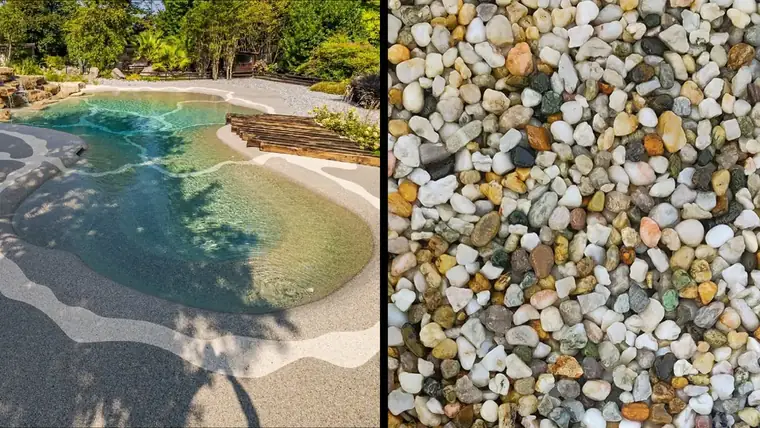
The first decision is colour and how it behaves in the sun. Pale stones, travertine, light limestone, certain sandstones, stay noticeably cooler than dark granite or basalt, which can become too hot to walk on barefoot by midday. Around a pool or a play area, that single choice decides whether the surface is usable in summer. We also look at the finish: a honed or lightly textured surface gives grip when wet without feeling rough, which matters enormously around water. For pool surrounds specifically, the choice connects closely to the waterline materials we discuss in our guide to natural stone and pebble pool finishes.
The challenge of salinity and humidity
For villas near the coast, salt is the hidden adversary. Salinity in the ground and in the air can attack porous stone and, more often, the mortar and substructure beneath it, causing salts to migrate up and leave white efflorescence on the surface. Dense, low-absorption stones cope far better than soft, porous ones in these conditions. Equally important is what happens below the surface: correct, salt-tolerant bedding, proper drainage and the right jointing compounds protect the installation for the long term. This is why the substructure deserves as much attention as the stone itself, a principle that runs through all our landscape work.
Laying it properly: the part you never see
Most stone failures are not failures of the stone. They are failures of preparation. A beautiful slab laid on a poor base will crack, lift, or stain within a couple of seasons. Proper hardscaping demands a stable, well-compacted sub-base, falls designed so water drains away from the villa and the pool, and a laying method matched to the stone and its setting. Joints should be sized and filled correctly, and movement allowed for in larger areas of paving. None of this is visible once the garden is finished, which is exactly why it is so often skimped, and why doing it right is the difference between a terrace that lasts decades and one that needs lifting within a few years.
Bringing stone together with the wider garden
Stone never works in isolation. The way paving meets planting, the transition from terrace to lawn, the steps that link levels, these junctions are where a garden either flows or feels disjointed. We use stone to lead the eye and the feet through a space, framing a beach pool, edging a planting bed, or forming the low walls that double as casual seating. When the same stone family threads through paths, walls and an outdoor living room in the UAE climate, the whole garden reads as one considered composition rather than a collection of separate features.
Caring for stone over the years
Natural stone is low-maintenance, not no-maintenance. A simple routine keeps it looking its best: occasional gentle cleaning, prompt attention to spills near dining areas, and resealing porous stones on a sensible cycle to resist staining and salt. Avoid harsh acidic cleaners, which etch many stones. Done sensibly, this light care lets the surface develop the soft patina that makes natural stone more beautiful with age, the opposite of a manufactured product that only ever looks worse than the day it was laid.
Get the hardscaping right and everything else, the planting, the lighting, the furniture, has a beautiful, lasting framework to sit within. If you are planning a garden, terrace or pool surround and want stonework chosen and laid to endure the Gulf climate, we would be glad to guide you. Start a conversation with our team at mahaam.ae and let us build something that only grows more beautiful with time.